Why Plain Text Accounting with AI Agents is the Future of Personal Finance
Modern budgeting apps are fragile SaaS silos. Here is how pairing double-entry bookkeeping with AI coding agents uncovered thousands in tax savings, broke the first-generation wealth trap, and proved why buying clarity beats buying cardboard.
Every six months, the tech world cycles through another batch of personal finance apps.
First came Mint, which degraded over a decade into an ad-bloated billboard before Intuit finally shut it down. Then came modern consumer SaaS alternatives like Copilot, Monarch, and YNAB. They feature slick mobile widgets, playful dark-mode gradients, and smooth onboarding screens.
Yet underneath the glossy interface, they all suffer from four fatal flaws:
- The Plaid Connection Death Loop: Bank OAuth connections disconnect without warning. You log in to check your net worth only to find that your primary checking account stopped syncing three weeks ago.
- The Single-Entry Trap: Most consumer apps treat money as a collection of loose buckets. If you transfer $5,000 from checking to your brokerage account, the app often flags it as an “expense” or creates duplicate entries that ruin your monthly cash flow reports.
- Privacy Vulnerability: You hand your bank credentials, account numbers, and complete transaction history over to a venture-backed startup whose business model depends on aggregating your financial life in the cloud.
- Zero Scriptability: If you hold unvested private company equity, multi-currency foreign banknotes, angel syndicate checks, or hardware cold-storage Bitcoin, the app simply cannot model it. You are back to maintaining a side spreadsheet.
A few months ago, I made a clean break. I deleted every cloud finance app, canceled every subscription, and rebuilt my entire financial operating system from scratch using Plain Text Accounting (hledger) paired with an autonomous AI coding agent.
What started as a simple privacy experiment turned into something much larger: an audit-proof personal family office that uncovered thousands in immediate tax savings, stopped silent financial paper cuts, and held up a brutally honest mirror to my lifestyle.
Act I: The Architecture (Why Plain Text + AI Wins) #
What is Plain Text Accounting? #
Plain Text Accounting (PTA) is the practice of tracking your finances in human-readable, plain text files using command-line engines like hledger, ledger, or beancount.
There are no databases to corrupt, no proprietary cloud locks, and no monthly fees. Your entire financial history lives in text files like 2026/checking.journal tracked inside a private Git repository.
A typical entry looks like this:
2026-09-15 Global Technology Group | Semi-Monthly Executive Payroll
    Assets:Checking:Primary                $8,450.00
    Expenses:Tax:FederalIncomeTax          $4,920.00
    Expenses:Tax:StateIncomeTax            $1,850.00
    Expenses:Tax:SocialSecurity              $980.00
    Expenses:Tax:Medicare                    $300.00
Income:Salary:Executive -$16,500.00Notice the structure: every dollar earned, deducted, and deposited is itemized, and the sum of all numbers in the transaction equals exactly zero.
This is not a software gimmick. This is double-entry bookkeeping, the mathematical foundation of global commerce since the Italian Renaissance.
Demystifying Double-Entry: The Invariant That Tames AI #
Most people avoid double-entry accounting because traditional textbooks bury the concept in archaic rules about debits and credits.
The core intuition is simple: Money never appears or vanishes into thin air; it only moves from a source to a destination.
In plain text accounting, your world is divided into five fundamental accounts:
- Assets: What you own (Checking, Brokerage, Real Estate, Hardware cold storage, Physical cash).
- Liabilities: What you owe (Credit card balances, Mortgages, Margin debt).
- Equity: Your baseline net worth (Opening balances from previous years).
- Income: Capital flowing into your universe (Salary, Dividends, Bonuses, Equity exercises).
- Expenses: Capital consumed by your lifestyle or taxes (Rent, Groceries, Dining, Travel, Taxes).
Every transaction is a transfer of energy between these accounts:
- When your employer pays you, money flows from
Income:SalaryintoAssets:CheckingandExpenses:Tax. - When you pay off your credit card, money flows from
Assets:CheckingintoLiabilities:CreditCard. Your net worth does not change; you simply traded an asset to cancel a liability. - When you buy shares of an index fund, money flows from
Assets:CheckingintoAssets:Brokerage:SPY.
Why This Matters for AI #
Large Language Models are brilliant at reasoning, pattern matching, and structuring messy information, but they are notoriously prone to arithmetic hallucination. If you ask an LLM to balance a budget in prose or spreadsheets, it will happily invent or drop a few dollars.
In hledger, every transaction must obey the fundamental double-entry equation: \(\sum \text{Postings} = 0\).
If an entry is off by even one cent, hledger check crashes with a hard compiler error.
This makes double-entry plain text the ideal sandbox for AI agents. The compiler provides a deterministic mathematical guardrail. The agent can parse messy statements and propose complex entries, but it cannot commit them unless the math balances to zero.
Frictionless Ingestion via AI Coding Agents #
The classic objection to plain text accounting has always been manual data entry. Typing out hundreds of transactions every weekend is a non-starter.
This is where autonomous coding agents change the equation.
In my setup, the agent is not a passive chatbot reading summaries. It acts as an active, forensic bookkeeper:
Frictionless Ingestion via Antigravity CLI Remote Control: Banks do not export
.journalfiles; they hand you messy CSV spreadsheets, PDF paystubs, and raw transaction exports. Whenever a statement closes or I download a new export, I feed the raw file directly into my Antigravity CLI Remote Control web interface with one prompt:“Here is my latest transaction export. Ingest it into my hledger database.”
Behind the scenes, the autonomous agent inspects the file structures, writes or runs the necessary ingestion logic, categorizes merchants against my Chart of Accounts, balances clearing accounts down to $0.00, and verifies that the ending balance in
hledgermatches the institution statement to the exact penny.Multi-Asset Portfolio Ingestion: Modern financial lives span fragmented asset classes that no commercial SaaS app can bridge:
- Liquid Brokerage & Cash: High-yield money market reserves, margin credit lines, and public index funds.
- Private Tech Equity: Vested pre-IPO company shares alongside startup syndicate SPVs.
- Cryptographic Assets: Physical Bitcoin on hardware wallets with on-chain UTXO tracking and Web3 multisig vaults.
- Tax-Advantaged Vehicles: Health Savings Accounts (HSA) and Backdoor Roth IRAs.
In
hledger, all of these live under unified, version-controlled commodity definitions. Bitcoin balances sync directly against blockchain APIs, private equity tracks cost basis alongside secondary valuations, and everything rolls up with a single command:hledger bs -VIn 50 milliseconds, you get an authoritative balance sheet valued at live market prices.
Act II: The Zero-Server Family Office (Visuals & Automation) #
Text files and terminal outputs are ideal for machines, but humans need visual pattern recognition to evaluate capital allocation.
Rather than running an active web server or database daemon, we compile the verified hledger database into a 100% self-contained static HTML5 dashboard.
With a single command:
task finance:dashboardThe system pulls updates across workstations, extracts financial statements into a clean JSON artifact, and opens a local, zero-dependency HTML dashboard natively in Safari or Chrome.
The dashboard renders:
- The Cash Flow Waterfall (Sankey Diagram): Tracing gross compensation through mandatory tax withholdings, living overhead, and retained surplus.
- The Taleb Barbell Asset Allocation: Visualizing net worth divided strictly into a 90% conservative core (Treasuries, broad market index funds, cash) and a 10% convex moonshot bucket (Bitcoin, venture secondaries, private tech equity), guarding against middle-ground traps.
- Granular Outflow Breakdowns: Interactive, tabbed category inspections of dining, housing, subscriptions, and retail spend.
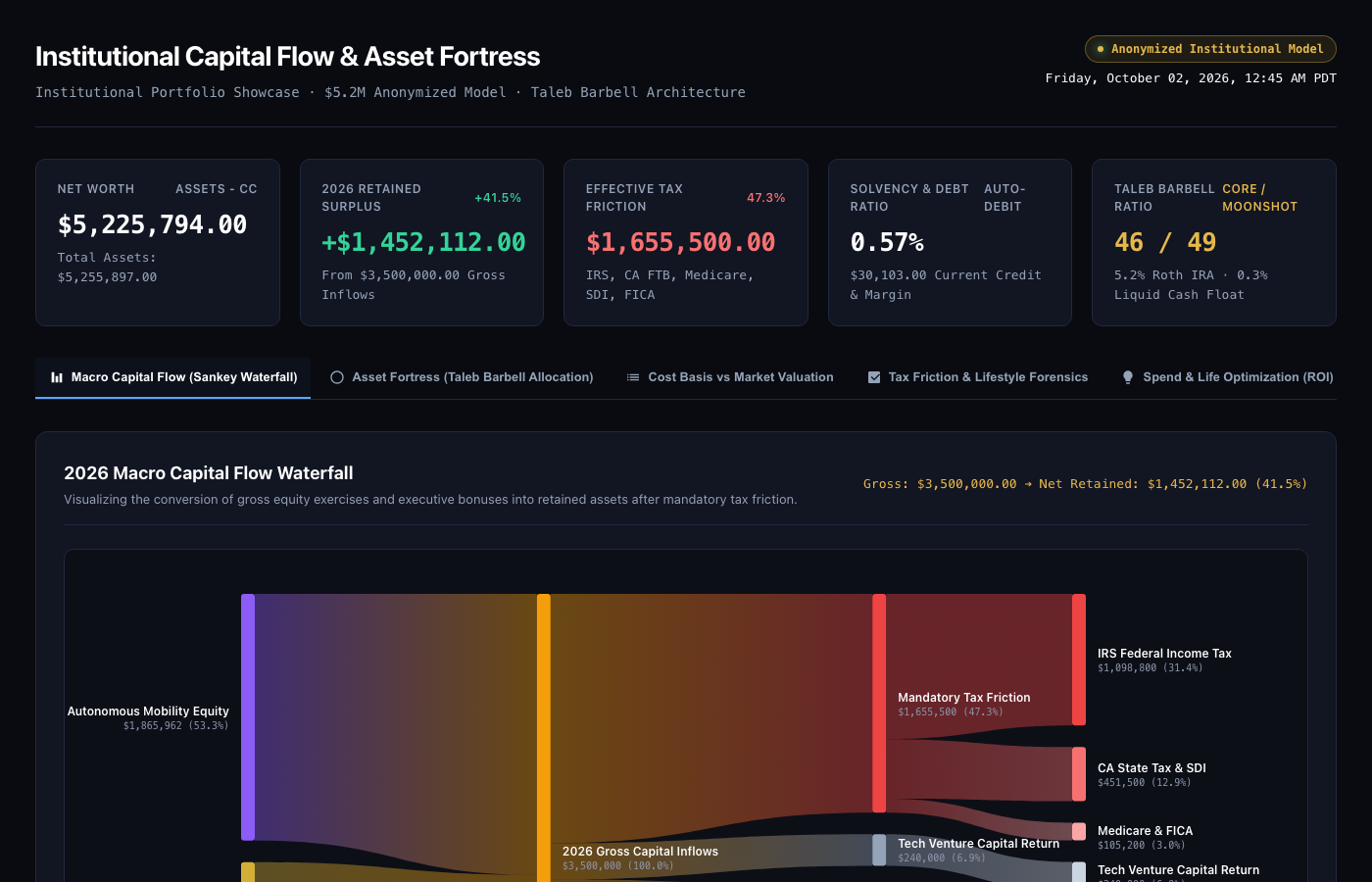
Figure 1: The zero-server interactive dashboard compiled from plain-text hledger journals. 👉 Explore the Live Interactive Demo Dashboard
Because the dashboard is pure static HTML and vector graphics, it requires zero ports, zero active processes, and zero background battery drain. You can AirDrop the file to your iPhone or keep it in your private notes, opening it offline anywhere in the world.
Closing the Loop with High-Level AI Reasoning #
Once your financial data is structured in plain text and verified by the double-entry compiler, you can close the loop with high-level AI reasoning:
task finance:analyzeThis script takes verified balance sheet numbers, constructs an institutional prompt, and pipes it directly into the Gemini LLM via the command line.
The AI does not produce generic platitudes like “Try dining out less.” Because it has access to verified tax withholdings, unrealized gains, margin interest rates, and asset allocation percentages, it delivers senior family office directives:
“Tactical Directive 1: Tax-Loss Harvest Gold Drag. Liquidate underperforming physical gold mini-shares carrying an unrealized loss before year-end to offset taxable realized capital gains and rebalancing distributions, capturing immediate cash tax savings.
Tactical Directive 2: S&P Mid-Cap Concentration Guardrail. Mid-cap equities represent nearly 50% of your public equity allocation despite comprising less than 8% of the broader market. Rebalance a portion of mid-caps into broad large-cap core and international equities.
Tactical Directive 3: Protect Roth IRA Convexity. Holding Bitcoin inside a tax-exempt vehicle provides pure asymmetric upside. Preserve this position permanently and continue executing maximum annual Backdoor Roth conversions.”
Act III: The Forensic Mirror (Three High-Value Discoveries) #
When your financial life is fragmented across separate bank logins, you suffer from structural blindness. An underperforming asset in a brokerage app just sits there as a red percentage, while your paycheck sits isolated in a banking app.
Running an unfiltered AI audit against a unified plain-text ledger revealed three immediate discoveries that paid for years of compute in seconds.
1. The Tax-Loss Harvest in Plain Sight #
In my portfolio, I held a legacy allocation in physical gold mini-shares (GLDM), carrying an unrealized loss of roughly 10%.
Because hledger unifies brokerage positions and payroll tax withholdings into a single relational ledger, my AI agent spotted what my wealth advisor missed:
- Under IRS rules, physical gold ETFs like
GLDMare classified as collectibles, subject to a 28% maximum long-term capital gains tax rate ceiling rather than the standard 20%. - In the same tax year, routine portfolio rebalancing and distributions generated significant realized taxable capital gains, while executive compensation pushed marginal ordinary income into the highest brackets (over 50% combined federal and California state).
- Liquidating the underperforming gold position before year-end captured an immediate capital loss. This loss offset realized capital gains dollar-for-dollar (while shielding the maximum $3,000 against ordinary income), generating thousands of dollars in immediate, cold cash tax savings.
2. Three Operational Blind Spots (Culprits and Habits) #
When I asked the agent to audit my lifestyle spending strictly from an objective third-person perspective, it uncovered three systemic habits:
- The Executive Paradox ($1,000 in Avoidable Fees): An executive directing eight-figure technical architectures paid over $1,000 in avoidable margin borrowing fees and finance charges. Why? Verifying statement auto-debits felt too pedestrian to schedule on a calendar. The audit diagnosed it: “A high-velocity thinker whose attention is absorbed by systemic architecture, leaving minor operational details to bleed in the background until forced into awareness by ledger reconciliation.”
- The Amazon Myth vs. The Snack Culprit: Credit card statements recorded over $12,000 spent across the year under Amazon, triggering guilt about lifestyle creep. Using Amazon’s official “Request Your Information” portal (under Account Privacy), I requested my complete order archive. After confirming the request via Amazon’s verification email, I dropped the resulting CSV into
hledger. The forensic breakdown showed that over 70% was non-recurring capital infrastructure for furnishing a new apartment (standing desk, ergonomic chair, OLED display, air filtration). What the audit caught instead was dozens of sporadic $10 micro-orders for packaged snacks and redundant cables. The financial cost was modest, but the habit created daily packaging clutter and fractured focus. - The Austere Cash Float Trap: The balance sheet showed deep liquid equity, but an operating checking account running on a razor-thin cash buffer of barely two weeks’ expenses. Starving checking to rush every dollar into investments caused the margin paper cuts whenever large bills cleared. The AI directive was immediate: establish a multi-month liquidity moat in Treasury money market funds yielding ~4.5% (fully exempt from California’s 13.3% state income tax).
3. The Dopamine Circuit Breaker: Eyevan Sunglasses #
When your ledger lives in plain text, your AI agent transforms from a retrospective accountant into a real-time behavioral copilot.
Traditional financial advice asks: “Can you afford this?” For anyone with a seven-figure balance sheet or executive earnings, a $1,000 pair of Japanese prescription sunglasses is mathematically irrelevant. A consumer app would shrug and approve the purchase instantly.
During an intense work sprint, I found myself eyeing a $1,000 pair of Eyevan sunglasses. Instead of impulsively pulling out my credit card, I opened the Antigravity CLI Remote Control web interface and asked:
“Can I buy these $1,000 Eyevan sunglasses today, or should I defer them? Look at my recent spending.”
The agent did not check my net worth. It analyzed my transaction velocity.
It pointed out that over the preceding three weeks, I had logged several non-essential retail purchases under the strain of long work hours. The agent delivered an objective diagnosis: the sunglasses were not a deliberate utility purchase; they were an acute dopamine craving triggered by work stress. It recommended a strict 14-day cool-down period.
I closed the browser tab. The impulse dissolved within forty-eight hours, the vicious cycle broke, and my mental focus returned entirely to my core work.
No commercial SaaS app will ever protect you from your own subconscious coping mechanisms. A local AI agent with full context over your financial life will.
Act IV: The Psychological Breakthrough (Escaping the First-Gen Wealth Trap) #
The sunglasses impulse pointed to a deeper psychological reality.
When you grow up without money, poverty leaves a lasting imprint on how you evaluate consumption. Even when your career accelerates and your wealth compounds, the only framework for spending you know is to buy faster, stronger, and larger physical things: the latest smartphone on release day, a bigger television, a faster car, a larger apartment. You measure your success by the visible accumulation of physical artifacts.
At the same time, first-generation earners carry deep working-class guilt around paying for personal services. Paying someone else to clean your living quarters, prep clean meals, or coach your biomechanics feels indulgent or shameful: “I have two hands, why should I pay someone else to do what I can do myself?”
When my AI agent analyzed my full transaction ledger, it held up a mirror that dismantled both assumptions.
It revealed that modern digital life had quietly introduced over $13,000 to $15,000 every year in unconscious, low-ROI friction:
- Direct Administrative Leaks: Between margin borrowing interest ($1,636), dormant cloud development instances and unused SaaS ($1,440), and 104 sporadic Amazon snack and cable micro-orders ($1,560), I was bleeding over $4,600 annually into pure administrative overhead.
- Material Hardware and Wardrobe Churn: Unconscious gadget accessories, redundant chargers, and impulse clothing upgrades consumed another $5,000 to $6,000.
- Delivery Platform Friction: Food delivery platform markups, service fees, and convenience takeout over clean home cooking quietly drained another $4,000.
Then the agent presented a surprising reallocation: the exact same capital, redirected, could fully fund institutional services that experienced allocators prioritize:
- Proactive Biomarker Surveillance & Body Composition: Rather than reactive healthcare, subscribing to comprehensive semi-annual blood panels tracking 100+ biomarkers alongside BodySpec DEXA scans ($750/year) to monitor arterial plaque risk, ApoB, fasting insulin, and visceral fat a decade before symptoms appear.
- Biomechanical Preservation & Recovery: Joining an elite athletic club in downtown San Francisco with daily hydrothermal sauna and cold immersion, paired with bi-weekly private coach check-ins for compound lifting mechanics ($4,200/year).
- Restorative Clinical Sports Bodywork: Scheduling bi-weekly 90-minute sports massage and Active Release Technique (ART) sessions ($3,600/year) with a dedicated practitioner to reverse the cervical spine and hip flexor compression caused by 12-hour engineering sessions.
- Clean Single-Ingredient Fuel: Shifting capital away from restaurant delivery markups and inflammatory industrial seed oils toward farm-direct, pasture-raised proteins and organic greens delivered weekly.
- Curated High-Rise Dinner Salons: Hosting quarterly 6-to-8 person curated dinner salons at home overlooking the Bay Bridge with private catering or prime wine pairings ($2,800/year), replacing noisy, crowded restaurant dinners with genuine relationship compounding among founders and peers.
The math was humbling. The net reallocation was a negligible fraction of annual compensation, but the difference in physical stamina, mental clarity, and biological recovery was profound.
The ultimate luxury that wealth unlocks is not faster gadget churn. It is the friction-free preservation of your time, your biological health, and your cognitive focus.
The Physical Artifact Bias and the 90-Day Executive Reset #
This analysis exposed an even deeper cognitive trap: the Physical Artifact Bias.
When you grow up in a working-class household, your intuition internalizes a rigid rule: If I spend $3,000, there must be a physical object sitting on my desk to prove I have it.
This explains why first-generation earners comfortably purchase a $3,500 workstation display, a $1,200 smartphone every September, or a $1,000 pair of prescription sunglasses. Looking at the desk, you see tangible hardware. It feels safe and real.
Conversely, spending $6,000 to $7,500 on a 3-night stay at a world-class wellness sanctuary (such as Sensei Porcupine Creek or an Auberge estate like Solage or Stanly Ranch) feels terrifying. On Monday morning, your hands are empty. You have no box to unwrap and no device to show anyone. The working-class instinct panics: “I just set a month of childhood rent on fire.”
Experienced wealth allocators operate on the reverse premise: hardware is a rapidly depreciating liability, while your biological nervous system is your sole revenue-generating engine.
When you lead complex engineering architectures or allocate balance-sheet capital, a single exhausted, brain-fogged decision can cost hundreds of thousands of dollars in bad executions or tax friction. A single week of profound mental clarity, normalized cortisol, and deep restorative sleep produces insights worth orders of magnitude more than the cost of the retreat.
Instead of treating luxury wellness getaways as an untouchable indulgence reserved for dynastic heirs, you can operationalize them through a simple 90-day playbook:
- The Cadence: Institutionalize two 3-night restorative retreats per year (for example, in May and November) as non-negotiable milestones on your calendar. Destinations within a short hop from the Bay Area (such as Sensei Porcupine Creek in Rancho Mirage for desert silence, Auberge sanctuaries in Napa like Solage or Stanly Ranch for geothermal bathhouses and bio-recovery circuits, or Post Ranch Inn above the Big Sur cliffs) eliminate travel fatigue while forcing total cognitive detachment.
- The Zero-Sum Trade: A 3-night comprehensive bio-wellness retreat (including thermal body mapping, targeted spa therapy, and clean nutrition) costs between $6,000 and $7,500. Running this twice a year totals approximately $12,000 to $15,000 annually. That matches the exact capital recovered by eliminating dead margin interest, mindless delivery markups, gadget churn, and retail clutter.
- The Ledger Rule: Create an explicit account in your Chart of Accounts:
Expenses:Vitality:Retreats. Fund it strictly by sweeping the recaptured cash from eliminated domestic and financial friction.
You do not need eight or nine figures to operate with institutional clarity. Your ledger already earns the capital; you simply have to grant yourself permission to buy clarity instead of cardboard.
Epilogue: How to Get Started in 15 Minutes #
If you want to escape the SaaS finance trap and take full ownership of your financial data, start small:
- Install
hledger: Download from hledger.org or install via Homebrew (brew install hledger) or Nix (nix-shell -p hledger). - Create Your Master Journal: Create a folder called
finance/and initialize a Git repository. Add anaccounts.journalwith your top-level accounts (Assets:Checking,Liabilities:CreditCard,Income:Salary,Expenses:Groceries). - Export One Statement: Download the last 30 days of transactions from your primary checking account as a CSV.
- Pair with Your AI Agent: Open your AI coding assistant (such as Antigravity CLI Remote Control), drop in your raw bank export, and simply say:
“Here is my checking account CSV. Ingest it into hledger and make sure everything balances.”
- Commit to Git: Once the compiler outputs clean zero-balance verification, run
git commit -m "feat(ledger): initial checking reconciliation".
You will never look at a third-party budgeting app the same way again.
Your financial truth belongs in your hands, in plain text, governed by mathematics and enhanced by intelligence.